


Duolingo have released a chess course, but can it actually make you a good player? I’ve spent 200 days testing it.
My chess starting point
I’ve known the basic rules of chess for a long time—I knew the “horsey” moved in an L-shape, pawns could move two spaces on their first turn, and I even knew about castling. But those basic rules were the limit of my knowledge. Every now and then, I’d try to ignite a “chess spark” by watching a YouTube video on an opening, but my opponent would inevitably do something the video didn’t cover and everything would fall apart. When Duolingo added a chess course, I thought it might finally offer the structured learning path I needed to actually get into the game.
What is Duolingo Chess?
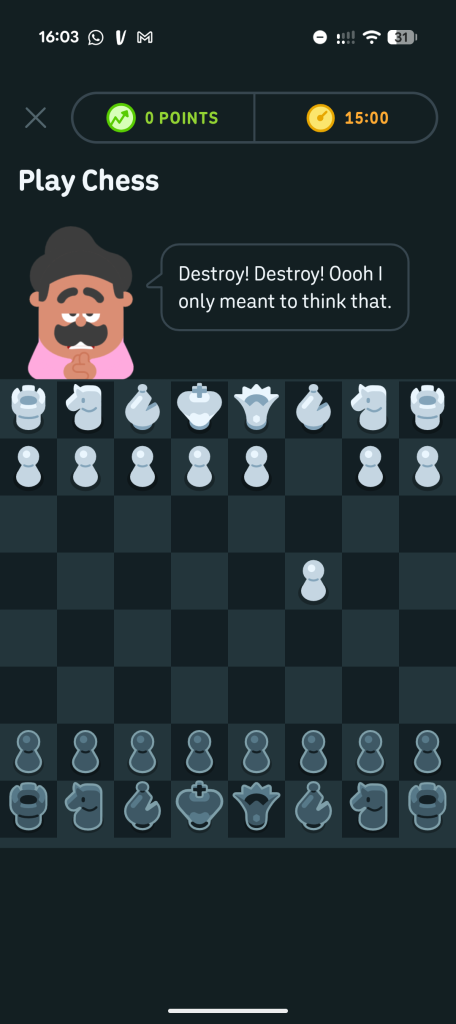
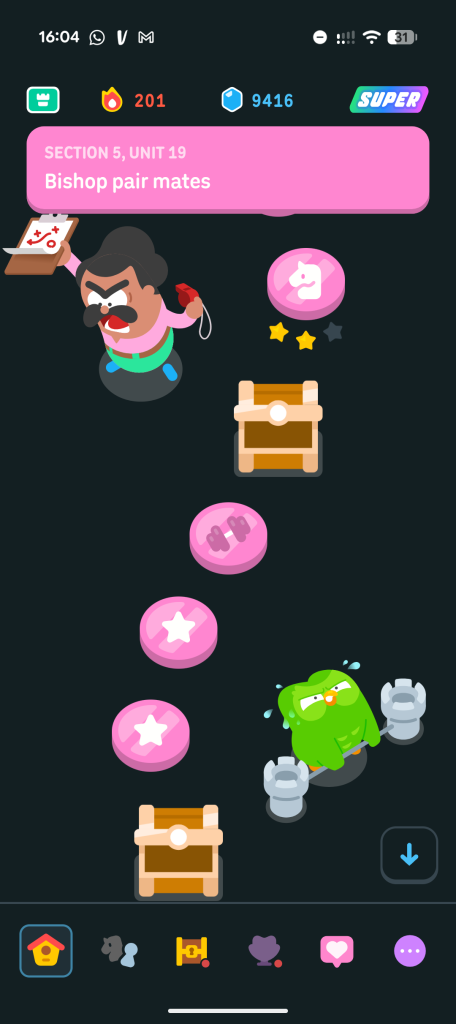
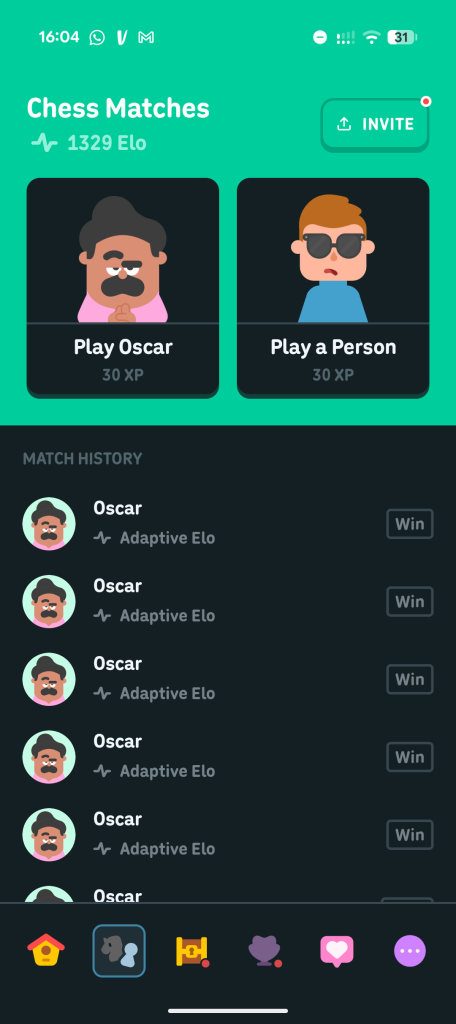
The course is divided into 7 sections spanning over 150 units. Each unit consists of lessons introducing new concepts, puzzles to cement those ideas, mini-games for positional awareness, and regular matches against their AI, Oscar. In a recent update, they also introduced the ability to play against real users with a similar Elo (the standard chess ranking score).
My experience
I am currently on Section 5, Unit 23, learning about interference and intermezzo. It has taken me 200 days to get here; in that time, I’ve played 242 matches and won 162 of them. Duolingo estimates my Elo to be 1329, though this figure comes exclusively from playing the AI.
What works well
- Lesson Structure: Every unit introduces a new concept followed by puzzles. This felt repetitive at first until I realized how much of chess is pure pattern recognition. The only way to spot a fork in a timed game is to identify them in puzzles hundreds (or thousands) of times. Repetition is part and parcel of the game.
- Regular Games: I like that you have to win a match in each unit to progress. As someone who dislikes losing, I definitely would have skipped the “playing” part if it were optional—constantly pushing it back until I felt “ready.” Being forced to play has kept my momentum going even when I wasn’t feeling confident.
- Playing Real People: This is a new feature, but it shows Duolingo is committed to the course and intends to become an all-in-one chess platform eventually.
What doesn’t work well
- No Game Review: There is no feature to analyze your games. After a win, I can’t tell if I played like the next Magnus Carlsen or if Oscar the AI just gave me blunder after blunder to capitalize on. To be truly effective, they need to introduce game reviews.
- The Adaptive AI: The AI adapts its difficulty to keep you challenged, but sometimes it feels like it throws the game if you haven’t won in a while. I suspect this is to keep learners engaged, but it often feels like wins are being handed to me on a silver platter. Without a review feature, playing the AI can occasionally feel pointless.
- No Openings: I’ve been on this course for nearly 200 days and we have yet to cover openings. I assume this is intentional—focusing on theory before memorizing lines—but openings can make or break a game. The only one covered so far is the Scholar’s Mate, and that’s mostly so you know how to avoid it. I had to independently learn the London System and the King’s Indian Defense from YouTube (shoutout to Chess with Akeem) just to have some structure. According to the syllabus, openings don’t appear until Section 6.
How good am I, actually?
To test my progress, I jumped over to Chess.com to play 10-minute games against real people.
The jump was significant. Human players are much more aggressive and far less likely to randomly blunder their Queen. While Duolingo has me at 1300+, my Chess.com Elo is sitting right around 630–650. Since Chess.com is the gold standard for rankings, it shows just how inflated the Duolingo AI scores can be.
| DUOLINGO | CHESS.COM | |
| ELO | 1329 | 656 |
Conclusion
I’m no Magnus Carlson, and I would still very much be classed as a beginner in chess. However, what the Duolingo course has given me is a fun, structured way to practice every single day.
There may be more efficient ways to improve quicker, but in my opinion Duolingo is the easiest to fit into your normal life. While I still suck at chess, It has introduced me and given me confidence in what is actually a fascinating and incredibly addictive game so for that reason, I’m going to stick at it.
If you’re interested in an update on my progress learning chess with Duolingo, sign up to my newsletter.